
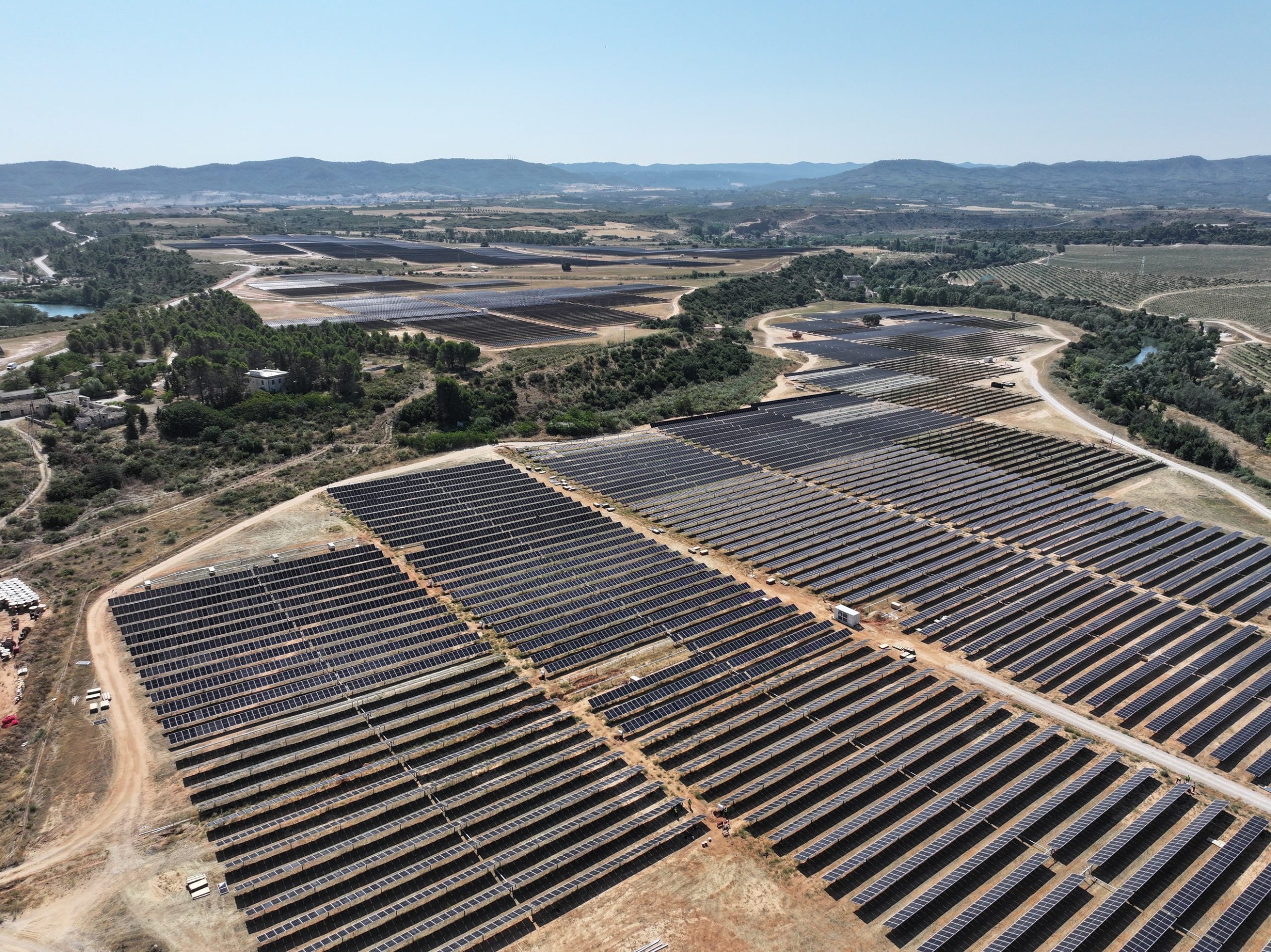
Naturgy has started up the Zorita I and Zorita II photovoltaic plants located between the municipalities of Almonacid de Zorita and Zorita de los Canes in the province of Guadalajara, near the former José Cabrera nuclear power plant. The commissioning of these facilities represents a further step forward in the company’s strategy of transforming and promoting the energy transition, with an operational renewable energy capacity of more than 5.5 GW in Spain.
Zorita I and II are home to around 92,000 photovoltaic panels and each facility has a capacity of 50 MW. They will be able to produce more than 200 GWh of renewable energy per year, equivalent to the annual electricity consumption of approximately 60,000 homes. This is enough to supply the city of Guadalajara for one year.
The start-up of these new plants has entailed an investment of €51 million, and almost 600 direct and indirect jobs were generated during the construction phase. Its contribution to the electricity system will prevent 133,100 tonnes of CO2 emissions per year, which is equivalent to taking 55,472 vehicles off the road.
Zorita I and Zorita II, located on a disused gravel pit, have been designed to blend into their natural surroundings, preserving the richness of the environment and promoting biodiversity. Work respected the plant reserve and large trees in order to preserve the environmental richness of the area, and bird guards were installed on the evacuation line.
Likewise, an Environmental Restoration Measures Programme has been launched in the Soto del Río Tajo River Reserve, aimed at restoring the riverbank ecosystem. This programme includes controlling invasive species such as the alianthus or red-eared terrapin, conserving pine forests, reforesting white poplar trees, studying water birds associated with marsh vegetation and monitoring the beaver population identified in the area.
Finally, in order to help the plants blend into the landscape, a vegetation screen and perimeter hedge will be installed at the points where the facilities are most visible, and in addition, a public-access perimeter path is being built for recreational, educational and environmental purposes.
This initiative contributes to the development of a fair transition area, as declared by the Spanish Ministry of Ecological Transition and Demographic Challenge, consolidating Naturgy’s commitment to sustainability and generating value in the territory. With the connection of these new plants, Naturgy has reached a total operational renewable generation capacity of 1,300 MW in Castilla-La Mancha.
Commitment to Castilla-La Mancha
The company operates 32 facilities in different provinces of the region. By technology, the group manages 12 wind farms: Loma Gorda, San Gil and Peña I (Tartanedo) and Canredondo I (Canredondo) in Guadalajara; Malagón I and Malagón II in Ciudad Real; and Los Pedreros (Fuente Álamo), Sierra de la Oliva (Almansa), La Losilla (Chinchilla de Montearagón), La Fuensanta (Peñas de San Pedro) and Casa del Aire I and II (El Bonillo) in Albacete.
In terms of photovoltaic technology, including Zorita I and II (Guadalajara), Naturgy already operates 10 solar plants. The Picón I, Picón II and Picón III (Porzuna) and La Nava (Almodóvar del Campo) plants are located in the province of Ciudad Real, while the province of Toledo is home to the Carpio de Tajo (El Carpio de Tajo) plant, which began operating in 2019, as well as Ocaña (Ocaña) and the Toledo PV plant in La Puebla de Montalbán, which is the oldest in Europe as it began operating in 1994. In addition, the Canredondo plant was commissioned in Guadalajara in 2021.
Finally, in terms of hydropower generation, the company operates nine hydropower plants in Castilla-La Mancha in the provinces of Guadalajara, Cuenca and Toledo, and one mini-hydro plant in Guadalajara.