
Naturgy has added seven new battery storage projects to its renewables portfolio and consolidated its position as a leading promoter of this technology in Spain, which plays a key role in guaranteeing the stability of the electricity supply and favouring the energy transition. The new projects bring Naturgy’s battery storage portfolio in Spain to a total of 16 facilities. Some of these plants are already under construction and will start operating in early 2026.
The seven new storage projects promoted by Naturgy have obtained €39 million of funding in the first call for grants for innovative energy storage projects, co-financed with ERDF 2021-2027 funds, as confirmed in the final resolution proposal published by the Spanish Government’s Institute for the Diversification and Saving of Energy (IDAE). These facilities will add an additional 100 MW of power and 359 MWh of storage.
The new projects will be located in the Canary Islands (Puerto del Rosario and Fuerteventura), Castilla y León (San Blas), Castilla-La Mancha (Los Pedreros), Galicia (Troncal and Monte Redondo) and Murcia (Jumilla). The new facilities include six of the company’s renewable plant hybridisation projects and a stand-alone battery connected directly to the grid in Vigo.
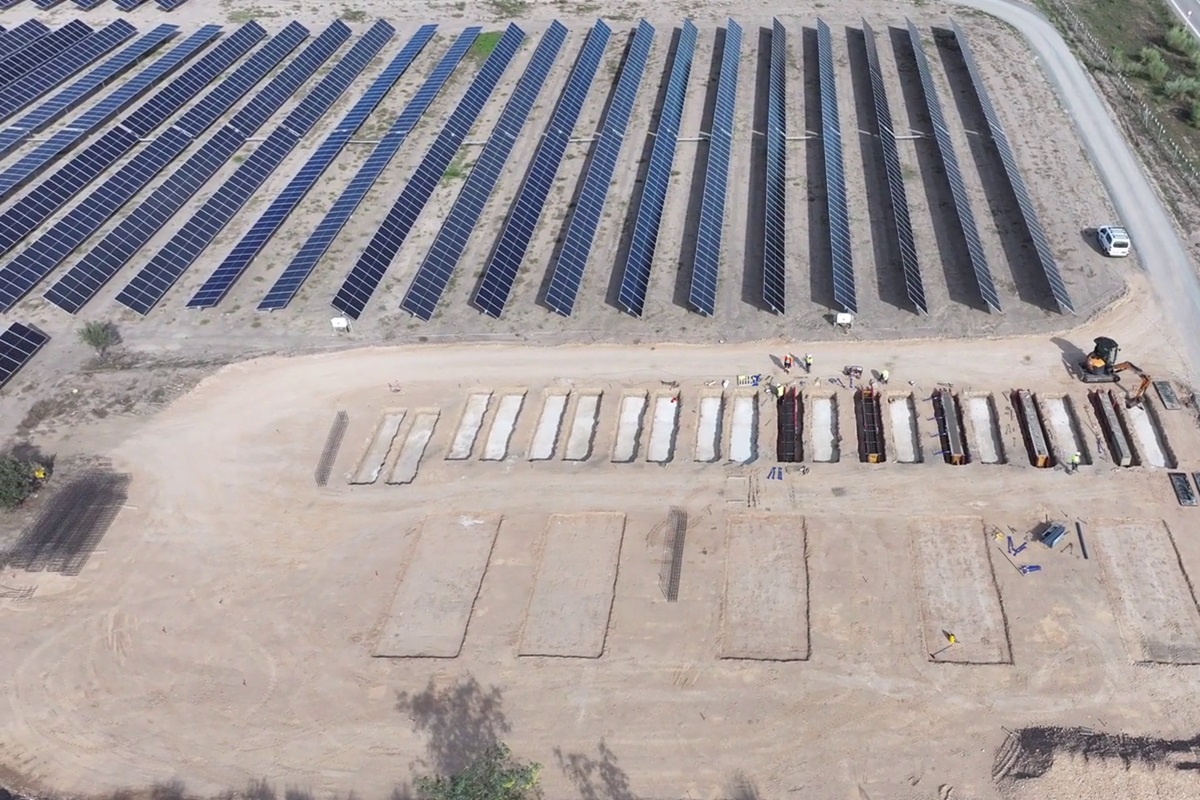
Naturgy recently began construction work on its first battery storage projects in Spain to hybridise the photovoltaic farms of Tabernas I and II (Almeria), Carpio del Tajo (Toledo), La Nava (Ciudad Real) and El Escobar and Piletas (Las Palmas), which are scheduled to come into operation in 2026.
The seven new projects awarded in the last auction take Naturgy’s storage portfolio to a total of 16 facilities with funding in development or under construction, totalling 260 MW of power and 689 MWh of storage capacity. These projects will involve a total investment of €140 million.
Battery storage, key to the energy system
These systems can store renewable energy to supply it later at times of lower production, bringing flexibility to renewable energy production and guaranteeing its integration into the system. According to projections from Spain’s National Integrated Energy and Climate Plan (PNIEC), 81% of electricity will be generated from renewables by 2030, which gives rise to the challenge of providing the system with flexibility tools to match generation and consumption and give the system firm capacity.
In this scenario, storage is key to supply security and quality, which is why the PNIEC foresees the installation of 22.5 GW of storage by 2030. In addition, in February 2021 the Government of Spain published its Energy Storage Strategy, in which stationary batteries are one of the keys to the flexibility of the electrical system.
International experience in storage
Naturgy has experience in developing battery storage at the international level. Through Global Power Generation (GPG), the group connected the ACT Battery project — its first battery storage facility worldwide — to the Australian grid in 2023. In 2025, it commissioned its first major hybrid photovoltaic and battery storage project in Cunderdin, Australia, with a solar capacity of 128 MW and a 55 MW/220 MWh storage system.